
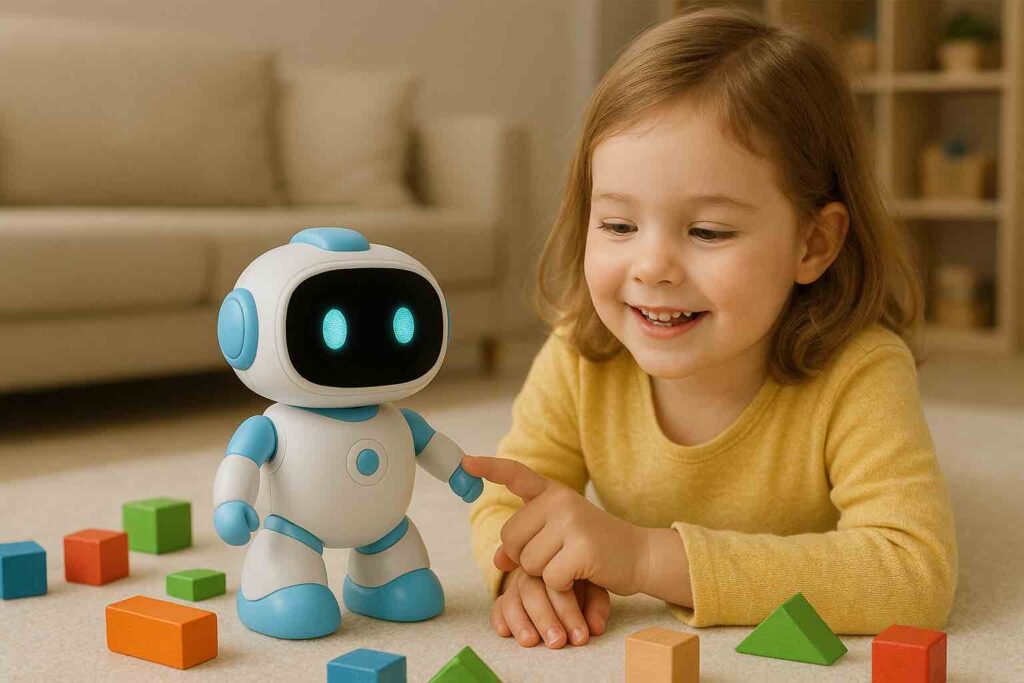
AI-powered children’s toys have quickly moved from novelty gadgets to mainstream products. From conversational plush companions and adaptive learning robots to smart dolls that recognise emotions, the new wave of interactive toys promises richer play experiences and personalised learning. But as capabilities grow, so do concerns around privacy, safety, data use, and developmental impact.
Below is an industry-aligned, accuracy-focused review of the state of AI toys today: what they offer, where they fall short, and what parents should know.
What AI Toys Get Right: Engagement, Learning, and Accessibility.
1. Natural, immersive interaction
Modern AI toys now use **speech recognition, natural-language models, and contextual memory** to hold surprisingly fluid conversations. Unlike earlier “talk-back” toys, these systems can respond to questions, tell stories, and adapt their tone to a child’s mood. For children who learn best through dialogue, this elevates the experience far beyond static play.
2. Personalized learning and pacing
AI educational toys, from programmable robots to smart reading assistants, adjust lessons based on a child’s performance. This allows:
• gradual difficulty scaling
• reinforcement of challenging topics
• tailored learning paths
For parents seeking meaningful screen-free STEM exposure, this is a strong value proposition.
3. Accessibility for children with learning differences
Some AI toys now include features to support:
• speech delays
• autism spectrum interaction assistance
• motor-skill development
• multi-language environments
These can complement professional support programmes when used responsibly.
Where Concerns Emerge: Data, Privacy, and Developmental Risks
1. Data collection and cloud processing
Most AI toys rely on cloud systems to process audio or behavioural data. This introduces risks:
• voice recordings stored online
• behavioral patterns analyzed for training
• ambiguous parental consent mechanisms
Without strict privacy standards, children’s data can be exposed to misuse, retention gaps, or third-party access.
2. Security vulnerabilities
Smart toys connected via Wi-Fi or Bluetooth can be targets for:
• remote access hacks
• location tracking
• unauthorized data interception
Historically, toy manufacturers have not met the security rigour expected in consumer tech a gap that remains concerning.
3. Emotional dependence
AI toys simulate empathy, companionship, and positive reinforcement. While beneficial in moderation, over-reliance may:
• distort expectations of real relationships
• reduce human-to-human interaction
• create emotional attachment to systems that don’t truly “feel”
Developmental psychologists caution that these toys should supplement, not replace, social play.
4. Biased or unfiltered responses
Even with child-safe models, AI can produce:
• inaccurate information
• unintended tone or suggestions
• culturally insensitive phrasing
Manufacturers are improving safeguards, but gaps persist.
Industry Insight: Regulation Is Lagging Behind Innovation
AI toy adoption is rapidly outpacing formal regulation.
Key challenges include:
• no universal standard for data handling in children’s AI products
• limited enforcement across jurisdictions
• slow audit processes for algorithms interacting with minors
Only a handful of regions (EU, UK, some U.S. states) have meaningful AI-for-children guidelines. Experts anticipate the introduction of dedicated “AI Toy Safety Standards” within the next 2–3 years as legislators react to market growth and parental concerns.
What Parents Should Look For Before Buying
✓ Clear data-handling transparency
Does the manufacturer specify what data is collected, where it is stored, and for how long?
✓ Offline mode or local processing
Edge-AI devices reduce exposure to cloud-based risks.
✓ Robust parental controls**
Time limits, conversation logs, and content filters are essential.
✓ Updatable safety patches
Regular firmware updates indicate a serious security posture.
✓ Age-appropriate interaction design
Younger children require constrained language models with high guardrails.
Final Verdict: Safe but Only With Informed Oversight
AI-powered children’s toys represent a major leap in educational engagement and interactive play, offering meaningful benefits across early learning and accessibility. But without strong parental oversight and industry-wide standards, risks around privacy, security, and emotional development remain real.
They can be safe if parents choose reputable products, monitor usage, and understand the underlying technology.
AI toys should complement human interaction, not replace it. The smartest toy in the room still needs the smartest guardian.
Read more on Tech Gist Africa:
The Impact of AI and Automation on Africa’s Workforce: Opportunities and Challenges
The Rise of Quantum Computing: What It Means for the Future of Global Innovation
The Role of Artificial Intelligence in Accelerating Climate Change Solutions